
The Three-Step Method for Finding Your Actual Healthcare Customer
Find Your Real Customers Through the Healthcare Buyer Decision Chain
A founder can do everything customer discovery is supposed to require, walk the streets, knock on doors, collect real signups from real people, and still build a company nobody will pay for. That's not a hypothetical. It's a documented pattern in healthcare specifically, where the person who says yes to a product and the person who pays for it are frequently not the same human being. Getting that distinction right, deliberately, in a specific order, is the difference between traction that converts and traction that quietly stalls.
Customer discovery as a formal discipline traces back to Steve Blank's Customer Development methodology, later popularized through Harvard Business School teaching materials on customer discovery and validation for entrepreneurs. The core instruction is simple: get out of the building and test your assumptions against real people before you build anything. What that instruction leaves out, and what healthcare founders discover the hard way, is that talking to real people is not the same as talking to the right real people. A founder can follow the letter of customer discovery and still validate the wrong node in a long, fragmented chain of healthcare decision-makers.
CB Insights, drawing on an analysis of hundreds of startup post-mortems, has found that a lack of product-market fit is the single most cited reason startups fail. Fit isn't just about whether a product solves a problem. It's about whether it solves that problem for someone who can actually authorize paying for it. That second half of the definition is where a documented, repeatable, three-step method becomes useful.
Why "We Did Customer Research" Doesn't Mean What Founders Think It Means
Alex Fair, founder of seven healthcare companies and Managing Partner at MedStartr Ventures, has a story that illustrates this gap better than most theoretical frameworks, because it's a case where the founder actually did the work and still got it wrong.
Fair's fourth startup, FairCareMD, aimed to bring price transparency to healthcare, a kind of Priceline for medical billing. Before writing a line of code, he wanted to test demand directly. Over roughly a hundred days, he walked into about a third of the doctors' offices in New York City and pitched them, one by one, on making their pricing transparent to patients. It took nearly a month to land the first signup. By the end of the hundred days, he had a hundred doctors on the platform.

By any conventional measure of early customer discovery, that's a strong result. Direct outreach, real conversations, real commitments, exactly the kind of "get out of the building" validation the methodology calls for.
The company still failed to gain the traction it needed. As Fair has explained it, the doctor wasn't actually the customer in that scenario, because doctors weren't the ones paying for it.
That's the distinction worth sitting with. Fair didn't skip customer discovery. He executed it well, against the wrong target. He validated that doctors would say yes to more transparent pricing. He never validated that the party controlling the money- insurers, billing structures, reimbursement rules- would let that transparency translate into a paying relationship. The signal he collected was real. It just wasn't the signal that predicted commercial success.
This is exactly the gap a structured, three-step method is designed to close.
Step One: Get Specific About Who You're Actually Trying to Reach
Fair has described the actual sequence he wishes more founders followed, starting well before product development: the first real step is market research, specifically getting down to who you want to connect with, and identifying who you can actually work with without burning out in the process.
That second half matters more than it sounds like it should. "Who wants this" is a much bigger, vaguer question than "who can I realistically build a sustainable relationship with." A hospital system, an individual physician, a health plan, and a patient can all want the same underlying outcome and still represent completely different sales processes, timelines, and relationship demands.

Getting specific here means naming an actual person, in an actual role, at an actual type of organization, not a category like "healthcare providers" or "hospitals." A pediatric dental practice manager and a hospital system's supply chain director may both technically fall under "healthcare buyers," but they make decisions on entirely different timelines, with entirely different approval chains.
The FairCareMD story is a useful cautionary example here too. Doctors were, by a reasonable definition, easy to reach: Fair could walk into their offices directly. That accessibility made them feel like the right first target. But easy to reach and correctly positioned in the purchasing chain are two different questions, and the first one is easier to feel good about answering.
Step Two: Reverse-Engineer How You'll Actually Reach Them
Once the specific person is identified, Fair's described method moves to reverse engineering: figuring out how to actually get in touch with them, how to talk with them, and how to get through whatever gatekeeping stands in the way.
This step exists precisely because "who is my customer" and "how do I access my customer" are separate problems. A hospital system's procurement lead might be exactly the right buyer and also nearly impossible to reach without an existing internal champion. A solo practitioner might be reachable in an afternoon but represent a purchasing decision with no real budget behind it.
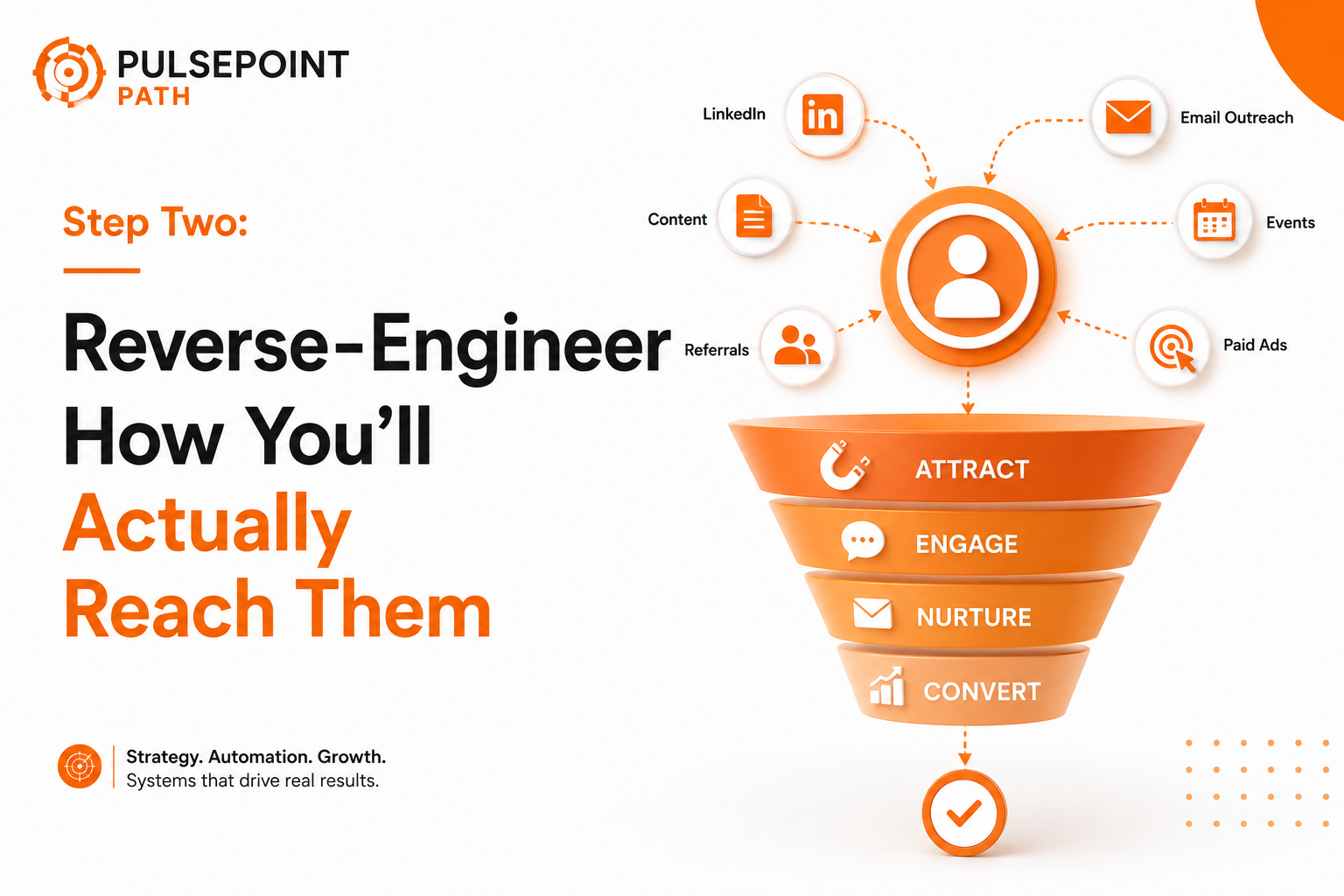
Reverse engineering means mapping the actual path: does this person respond to cold outreach, or does access require a warm introduction through a specific professional association? Is there a gatekeeper, an office manager, a compliance department, a group purchasing organization, standing between the founder and the decision-maker? What does that gatekeeper actually need to see before granting access?
Skipping this step is how founders end up with technically accurate customer research that never converts into a repeatable sales motion. Knowing who the customer is doesn't help if there's no realistic, repeatable way to reach enough of them to build a business.
Step Three: Build the Offer to Match the People You Identified
The third step, in Fair's framing, is creating the actual solution or offer that matches the people identified in steps one and two, not the other way around.
This is the step most founders get backward, according to Fair, who has described the more common, reversed pattern directly: founders build a solution first, then hope people eventually understand why they need it. The product exists, the reasoning behind it feels obvious to the person who built it, and the assumption is that the market will catch up to that clarity on its own.
It rarely does. A solution built before the buyer is specifically identified tends to solve a general version of the problem, which is a different thing from solving a specific decision-maker's actual, budgeted, urgent version of it.
Building the offer last, once steps one and two are genuinely complete, means the product can be shaped around real constraints: the buyer's actual budget cycle, their actual approval process, the actual language their organization uses to describe the problem. That's a very different starting point than building something broadly useful and then searching for whoever might want it.
Practical Takeaways
Before starting any customer conversations, write down a specific role at a specific type of organization, not a broad category like "clinicians" or "hospitals."
Separate the question of who wants this from the question of who can approve paying for it. Those are frequently different people.
Map the actual access path to that specific person before assuming outreach will work. Identify gatekeepers and what they need to see.
Resist building the product until steps one and two are done. A specific, well-understood buyer should shape the offer, not the other way around.
When early traction looks strong, ask directly whether the people saying yes actually control the budget, or whether they're simply the most accessible people in the chain.
Where This Method Breaks Down in Healthcare Specifically
Healthcare complicates all three steps in ways that consumer markets generally don't.
The chain between "person who benefits" and "person who pays" is often three or four links long. A patient benefits, a clinician recommends, a hospital or practice approves, and an insurer ultimately reimburses, or declines to. Each link has its own incentives, timelines, and approval requirements. Fair has pointed this out directly: even once a startup gets past doctors and hospitals, insurance companies frequently aren't the real decision-makers either, because it's ultimately the people paying for the insurance whose behavior matters most.
That's not a reason to avoid the three-step method. It's the reason the method needs to be run more rigorously in healthcare than in most other industries, because the cost of validating the wrong node in the chain is higher, and the chain has more nodes to get wrong.

Founders who run all three steps correctly, but only once, against a single assumed buyer, are still exposed to this risk. In a fragmented healthcare buying chain, it's often worth explicitly testing more than one candidate buyer against the same three-step process before committing to a go-to-market strategy, rather than assuming the first accessible, receptive contact is the right one.
If your current traction consists of enthusiastic conversations that haven't yet turned into signed contracts or purchase orders, that gap is worth investigating specifically through this lens. HBA's guidance on investor readiness covers how founders can build the kind of go-to-market clarity that holds up under real investor scrutiny, which starts with exactly this distinction between engagement and actual purchasing authority.
FAQ: Finding Your Actual Healthcare Customer
Q1: How do I know if I've identified the right buyer, not just an accessible one? A1: Ask directly, in the first real conversation, who else needs to approve this and what budget it would come from. If the person you're speaking with can't answer that clearly, they may be a strong advocate but not the actual decision-maker.
Q2: Isn't it normal for early customer discovery to involve some trial and error? A2: Yes, and the three-step method doesn't eliminate that. What it does is make the trial-and-error deliberate rather than accidental, by forcing a specific hypothesis about who the buyer is before testing it, rather than treating any positive response as validation.
Q3: What if the easiest person to reach really is also the decision-maker? A3: That happens, particularly with solo practitioners or small practices making their own purchasing decisions. The risk isn't that accessible contacts are always wrong; it's assuming they're right without explicitly checking.
Q4: Should I test more than one type of buyer at the same time? A4: Often, yes, especially in healthcare given how fragmented the decision chain tends to be. Running the three-step method against two or three candidate buyers in parallel, early, is usually faster than discovering eighteen months in that the wrong one was chosen.
Q5: How is this different from a typical customer discovery process? A5: It isn't fundamentally different in spirit; both are rooted in the same "get out of the building" principle. The difference is sequencing and specificity: identifying a precise buyer, mapping real access to them, and only then building the offer, rather than validating enthusiasm in the abstract and assuming the buying process will sort itself out later.
If your team has strong engagement but a purchase decision hasn't followed, that's usually a sign the wrong node in the healthcare buying chain was validated first. Apply through Health Board Advisors to work through go-to-market clarity with operators who have run this exact diagnosis before.
